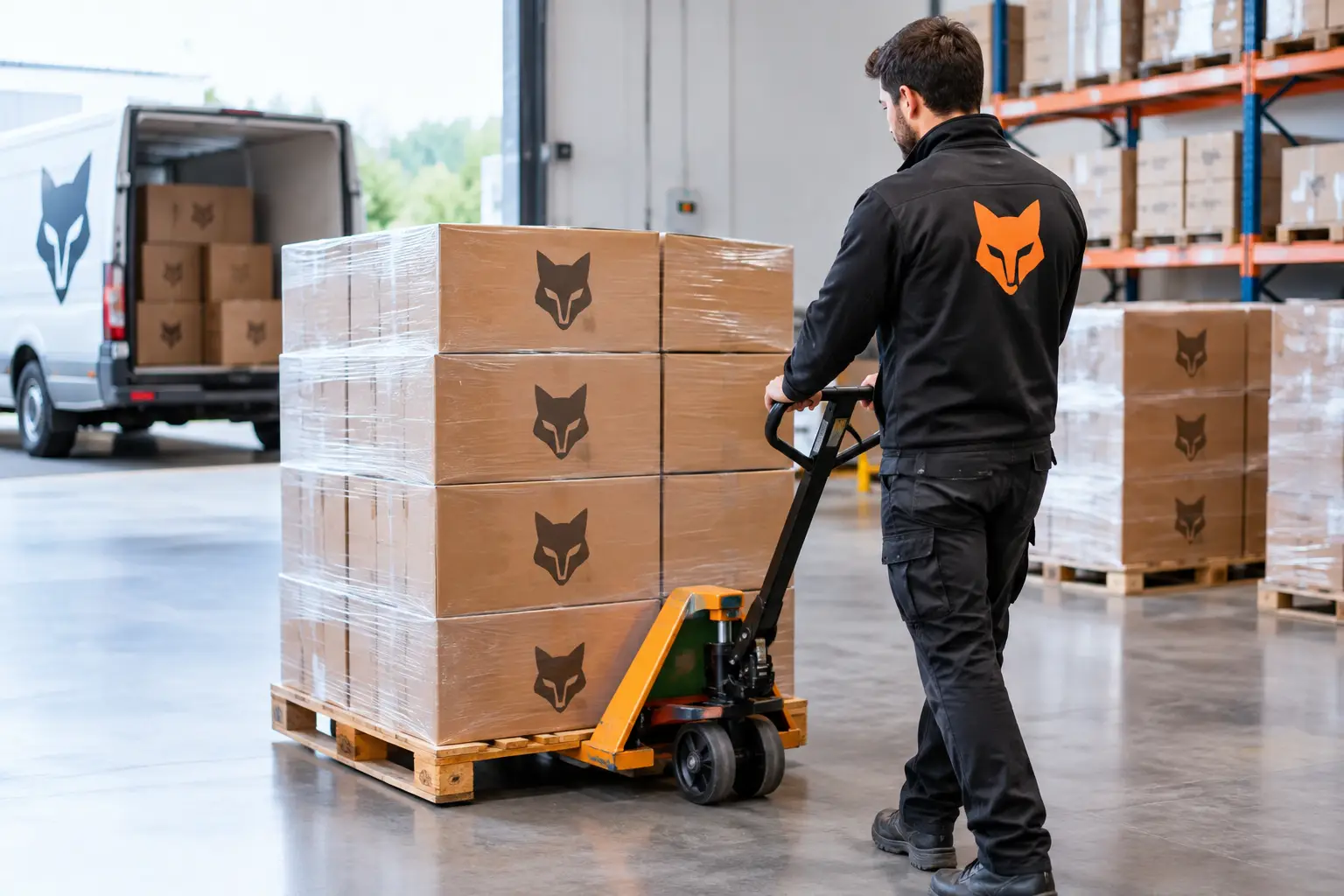
Pallet storage for ecommerce cuts fixed costs, improves stock control and lets you grow without expanding your own warehouse or team.
A poorly managed pallet doesn't just take up floor space. It can tie up capital, hide stock shortages and delay hundreds of orders just when a campaign starts to take off. Ecommerce pallet storage solves that physical side of the operation with a clear unit of cost and control: you know exactly how much space your inventory occupies, which SKUs it contains and when you need to replenish it.
For a digital brand, it's not simply about storing goods. It's about maintaining availability without paying for an oversized warehouse, fulfilling orders without losing accuracy, and scaling sales without turning logistics into a new department to manage.
What ecommerce pallet storage actually is
Pallet storage means grouping goods on pallets in identified rack positions. Each unit is logged and linked to its SKU, batch, quantities and status, and becomes available to feed picking zones as orders come in.
This model is particularly efficient for online shops that receive stock from manufacturers, importers or distributors in master cartons and large quantities. Rather than manually counting every unit at each delivery, the operator checks the goods in, labels and logs the pallet, and assigns it to a traceable location.
The advantage isn't simply stacking higher. It's about separating two distinct rhythms: reserve stock and picking stock. Reserve stock stays neatly organised on the racking; the units needed for daily orders move to picking locations. This cuts down on unnecessary movement, speeds up order preparation and protects inventory accuracy.
When it makes sense to move to a pallet model
The tipping point usually arrives sooner than most teams expect. At first, storing boxes in an office, a storeroom or a small warehouse can work fine. But the system stops being viable once every delivery forces a reshuffle of the space, the team takes too long to locate items, or stock on Shopify no longer matches physical stock.
Pallet storage starts to make sense if you receive recurring restocks of several boxes per SKU, manage fast-moving lines, run seasonal campaigns or need to hold safety stock. It's also a logical option if you sell across several channels and want a single source of truth for inventory.
Not every brand needs the same volume to benefit. A shop with 200 orders a month might need it simply due to lack of space, or in anticipation of growth. Another with 10,000 orders a month might need it to cut errors and keep dispatch times competitive. The deciding factor isn't just order volume: it's the operational complexity behind it.
Signs your own warehouse is already holding back sales
Friction shows up when the sales team can't launch a promotion because they're not sure there's capacity to fulfil the orders. It also shows up when the business relies on spreadsheets to track receipts, adjustments and returns, or when an inventory error causes cancellations that damage customer trust.
Another sign is hidden cost. Rent is easy to measure, but the hours spent on receiving, restocking, picking, training temporary staff, packing, courier issues and supervision often aren't. If every demand spike means hiring, reorganising and firefighting, the operation isn't scaling: it's soaking up resources that should be going towards growth.
How the operation should work
A good ecommerce pallet storage system doesn't start with the racking. It starts with controlled receiving. When goods arrive, quantities, references, product condition and any discrepancies against the delivery notice are checked. Any issue is logged before the stock becomes available for sale.
Each pallet is then identified and placed. Traceability should make it possible to know exactly what's in each position and, where relevant, track batch, expiry date or serial number. This is critical for cosmetics, non-perishable food, supplements, electronics and any category with specific rotation requirements.
Replenishment links reserve storage with picking. If a picking location drops below its minimum level, the system generates or flags a restocking task. The picker doesn't wander the warehouse hunting for boxes at random: they work off defined routes and locations.
Finally, dispatch closes the loop. Wave picking groups compatible orders together to reduce travel time. Double-checking by barcode scan confirms SKU and quantity before packing. The order is labelled with the most suitable courier based on destination, weight and delivery requirements, and inventory is updated in real time.
Technology stops the pallet from becoming blind stock
Having goods in storage isn't the same as having sellable stock. A pallet might contain damaged goods, items pending inspection, unsorted returns or SKUs that aren't yet synced with the shop. That's why the system needs to distinguish between inventory statuses and communicate available units to sales channels without delay.
Integrations with Shopify, PrestaShop, WooCommerce or Squarespace remove much of the manual work. The order comes in automatically, its status updates through picking and dispatch, and tracking is sent back to the end customer. The ecommerce team stops exporting files and can make decisions based on up-to-date operational data.
How to work out the real cost per pallet
Pallet-based pricing brings predictability, but it needs to be assessed alongside the operational cost per order. A low storage rate might look appealing on its own, but it stops being a bargain if goods-in is slow, orders are picked with errors, or restocking generates charges that are hard to anticipate.
To compare options properly, calculate the full monthly cost: storage, receiving, order preparation, packing materials, shipping, and handling returns and issues. Then add the internal cost that would disappear by outsourcing: rent, warehouse managers, staff, equipment, software, insurance and unproductive space.
Volume and turnover change the equation. A brand with stable inventory and fast turnover can optimise its pallet count through more frequent restocking. A seasonal brand might prefer to pay for extra storage during certain months to guarantee availability for Black Friday, sales periods or a launch campaign. There's no universal ratio of pallets per order. There's a structure that needs to fit each business's buying cycle, margin and demand forecast.
Mistakes that push up storage costs
The first is sending goods without prior notice or clear labelling. This slows down receiving, increases discrepancies and delays product availability. The second is mixing up SKUs or variants without consistent identification. A wrongly placed colour, size or pack can end up in the wrong order.
It also hurts to treat all inventory the same way. Fast-moving SKUs need to sit close to the picking area; slow-moving products can stay in reserve. Applying the same process to both groups makes every movement more expensive.
Finally, many brands only check stock when a problem crops up. Cycle counts, minimum-level alerts and turnover analysis make it possible to spot discrepancies before they turn into lost sales. Control shouldn't depend on an annual stocktake or on one person's memory.
Turning space into growth capacity
Outsourcing storage doesn't mean losing control. Done properly, it means swapping manual tasks for visibility: inventory by SKU, orders in progress, dispatches, issues and returns all from a single workflow. Furgox, for example, combines pallet storage with pick, pack and ship in under 24 hours, so physical space never limits your sales pace.
The best decision isn't to use as few pallets as possible. It's having the right inventory, in the right location, with reliable data and the capacity to ship it the moment a customer buys. If your next campaign demands more space, more accuracy or more speed, that logistics decision needs to be made before the first order comes in.
By - Equipo de Furgox
Escribimos sobre lo que vemos cada día moviendo pedidos desde nuestro hub en Murcia.